
Ten Thematic Units that Integrate the Four Domains of Language

Reading for Beginner English Learners

Family

Happy Readers

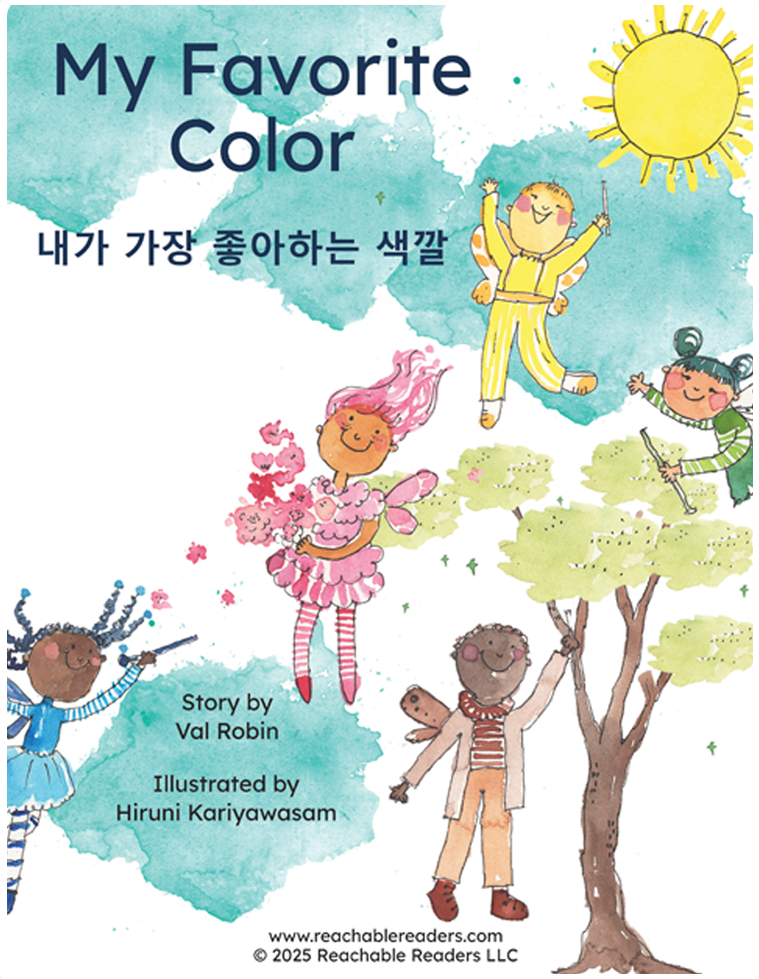
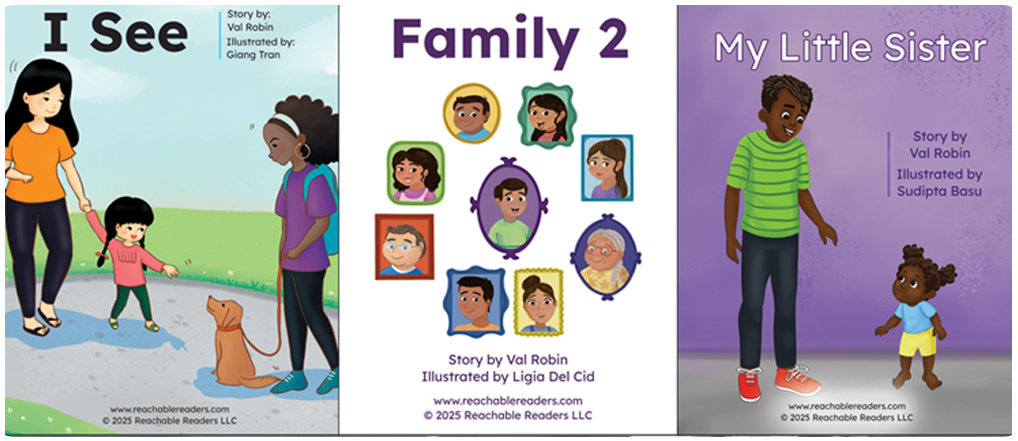
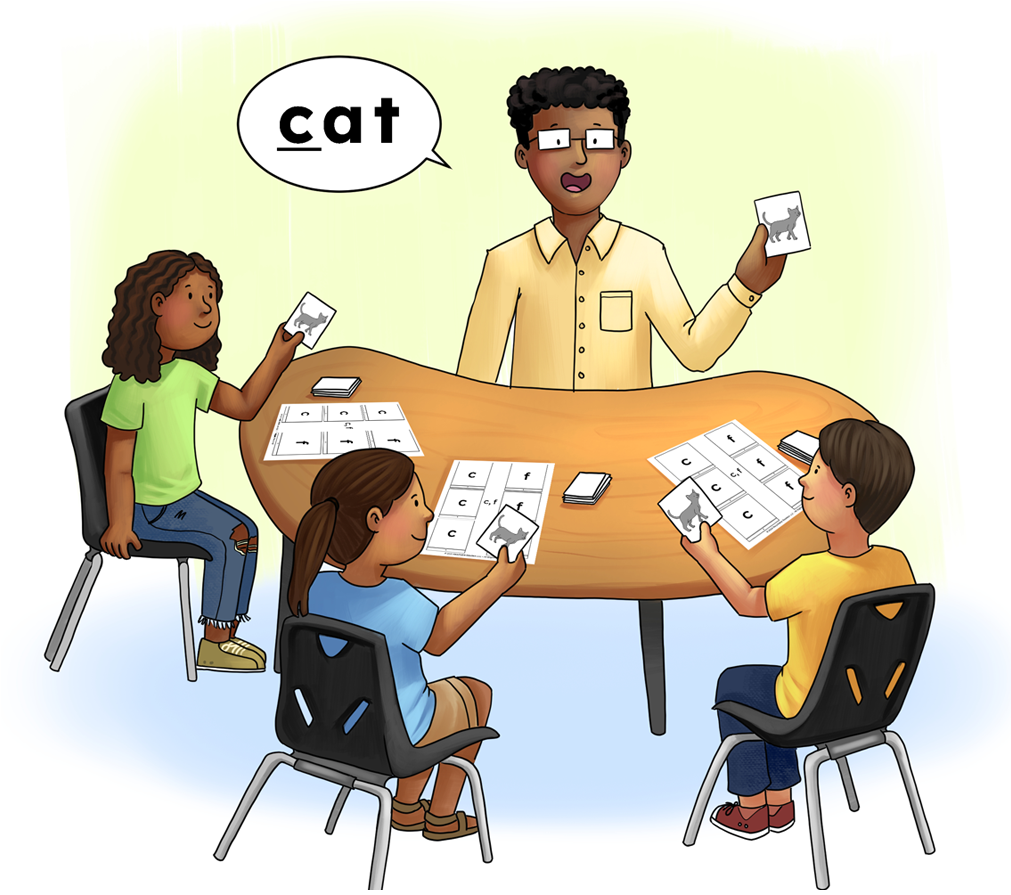
At Reachable Readers, the goal is for every kid to develop a love for reading. That is why every book is printable, in students’ hands, and the program includes 35 original books. The hope is that your students will take the books home, read them to their families, and lie in bed reading them over and over to themselves. Although the language inside consists of single words and simple phrases or sentences, the content is rich, and the stories have creative plots. The books are appropriate for a variety of ages, with both young children and teenagers represented in the pictures.
See below to find out how Reachable Readers uses purposeful lessons to help students gain the oral language skills they need to comprehend the text.

Oral Language Development, Reading, and Writing

With Reachable Readers, beginner multilingual learners engage in oral language activities that prepare them to read and understand the texts provided. Using meaningful contexts, students are first taught the core vocabulary needed for the thematic units. Once books are introduced, students have already received direct instruction and opportunities to engage in real communication using the same core vocabulary and skills that are presented in the books.

Students will begin to learn foundational reading and writing skills by practicing phonemic awareness and phonics through clear, systematic lessons. The phoneme/grapheme exercises are presented using pictures and often include hands-on, interactive activities.

Books and Writing Opportunities That Support Language Growth

Within each thematic unit, the books support students’ language development by helping them hear and see simple patterns of English. Exercises designed to help students write also help them recognize language structures. Throughout the program, there is a reciprocal relationship among all four language domains: listening, speaking, reading, and writing.

Sight Words

Ten sight words are taught through context. These sight words are also repeated throughout the series in a variety of modalities (activities, worksheets, and books) to further reinforce learning. They are never taught in isolation; instead, they are taught within the context of the English language.
Note: Core sight words are available in 18 languages. If a student’s home language is not one of the options, or if there is no direct translation for the sight word, the student will use the English-only version. All sight words are presented in context and with pictures.

Illustrations From Around the World

Culturally Sensitive

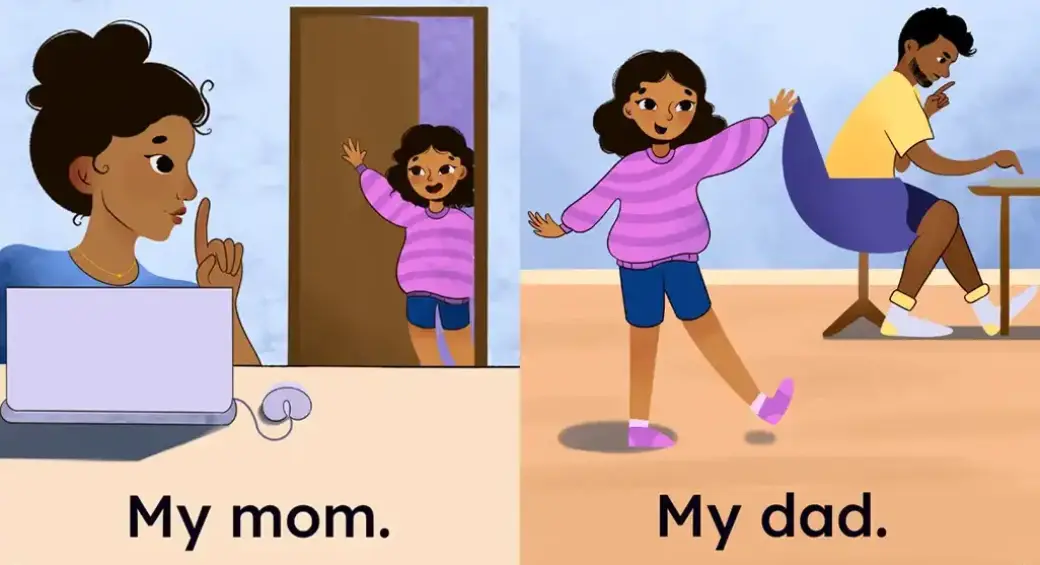
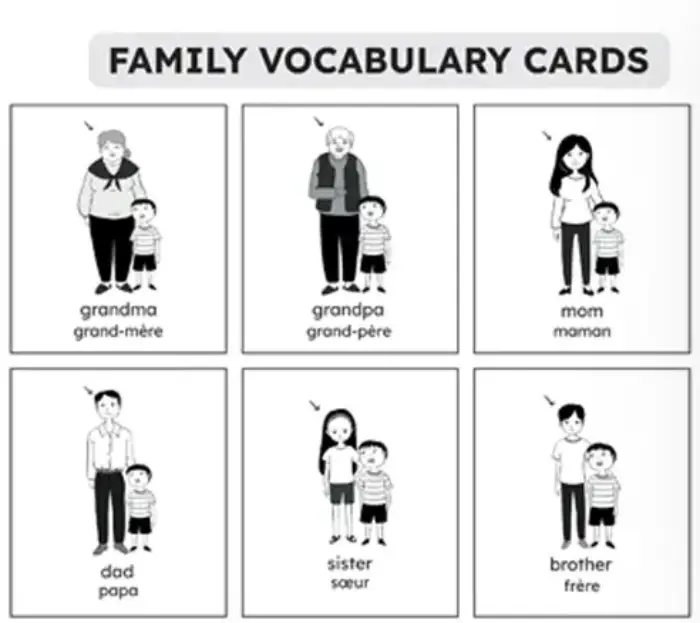
Books, flashcards, and worksheets were developed with a multitude of cultures represented. The illustrators for this program come from around the world, including Mexico, El Salvador, Philippines, India, China, Vietnam, Kenya, Uruguay, Venezuela and the United States. A core value at Reachable Readers is for students to see themselves on the pages.

A core value at Reachable Readers is for students to see themselves on the pages.

Sight Words

In context, ten sight words are taught. The sight words are repeated throughout the series within a variety of modalities: activities, worksheets and books. They are never taught in isolation. All sight words are available in eighteen languages with the exception of those languages that do not have a one-to-one translation.

Explicit and Systematic Instruction

Students Listen for Initial Consonant Sounds

Phonemic Awareness and Phonics

Reachable Readers is designed to be accessible for all emergent multilingual learners, including students who do not have foundational reading skills in their native language.  For students who have never read in their native language, a heavy dose of phonological awareness skills is generally needed. At Reachable Readers, students are learning to hear and identify ten phonemes. Using multimodal activities, students are shown how the sounds are represented by letters. At the same time, students are working on gaining oral language skills and beginning to write in English.

Language Grows, Repeats and is Continuously Reinforced Throughout the Series

Introduce Vocabulary
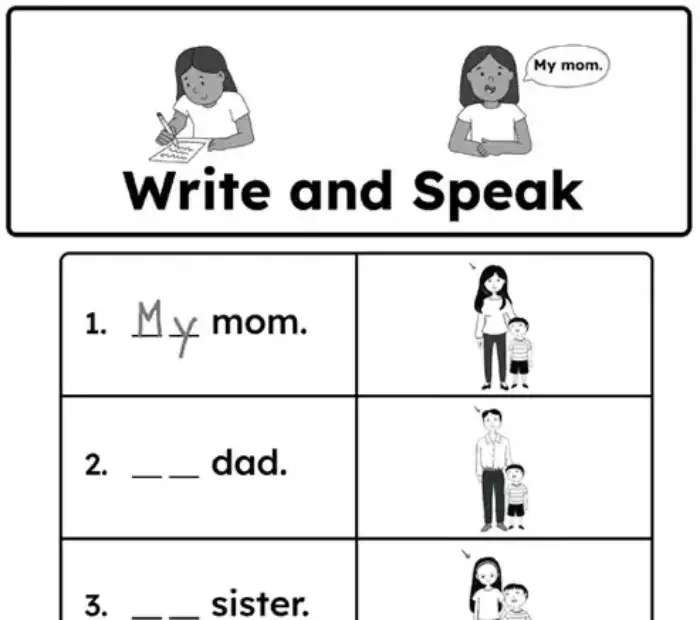
Reinforce Vocabulary with Writing
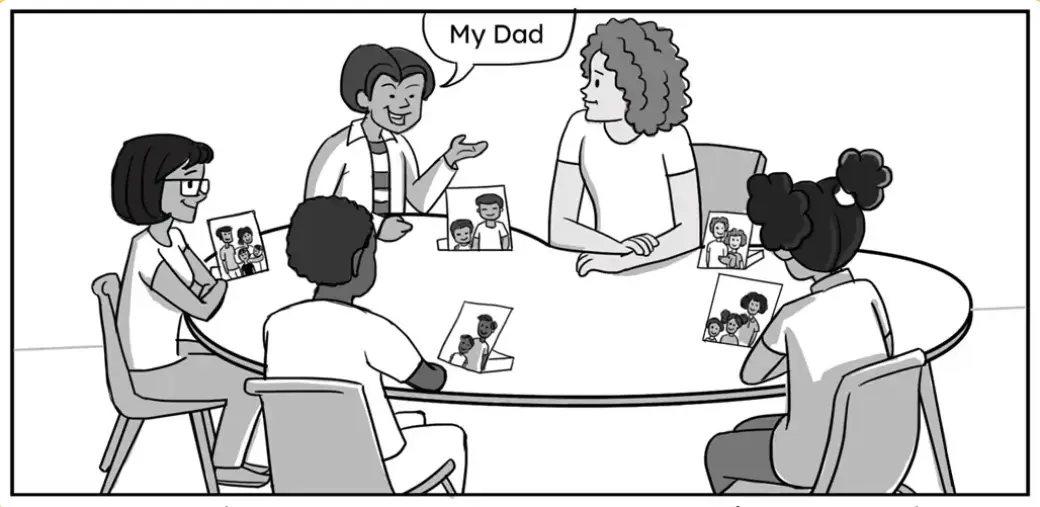
Reinforce Vocabulary with Oral Language

Reinforce Vocabulary with Reading

Vocabulary

Vocabulary is reinforced again and again within the books as well as within the activities. A student will never be presented with a book where the language is unfamiliar or there is no identifying picture. All vocabulary words are either (1) learned from a previous unit, (2) scaffolded in the pre-reading section of the current unit, (3) represented by a picture that identifies the word, or (4) translated directly in the book or worksheet.

Repetition and Reinforcement

Students need a tremendous amount of repetition in order for new vocabulary to become part of their lexicon. Reachable Readers was developed so that vocabulary and language chunks would reappear and be reinforced throughout the program.

Language Complexity

Reachable Readers corresponds with the early developmental stages of multilingual learners. Reachable Readers begins with single words and short phrases and ends with simple, present tense sentences. Through multimodal learning, students learn to use verb phrases, noun phrases, plural nouns and present progressive verbs.

Unit Specific Materials are Available in Eighteen Languages

Translanguaging

Research suggests that students learn best with bilingual education. This can be difficult to achieve in today’s classrooms which often consists of diverse home languages. Reachable Readers uses a translanguaging approach. When possible, native language is used to help students understand the material and to incorporate individuals’ culture into the learning.

All key vocabulary and sight words are provided in 18 languages as long as there is a one-to-one translation. For noncontextualized language or when a scaffold is not available, translations are provided directly in the books or worksheets.

Ninety English/Spanish Cognates to Support Spanish Speakers

For Spanish Speakers

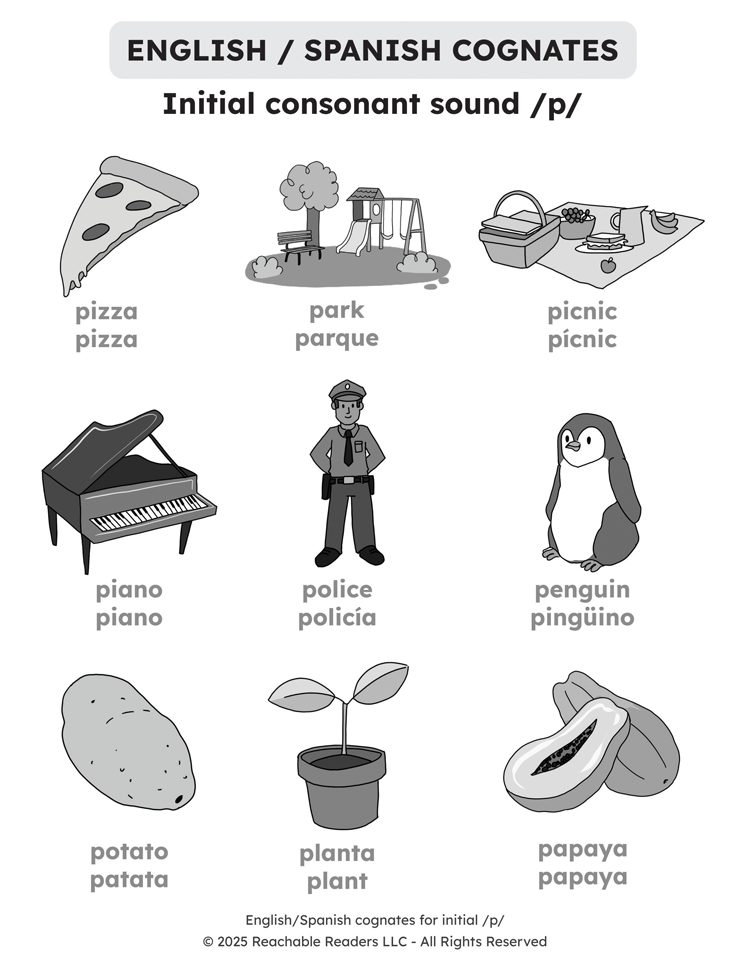
As Spanish speaking students often represent the majority of multilingual learners in the United States, Reachable Readers has additional tools for this population. There are ninety picture cards with English/Spanish cognates.

Students who can read in Spanish: For Spanish speaking students who can read in their native language, the cognates are used to demonstrate similarities between English and Spanish.

Students who cannot read in Spanish: For Spanish speaking students who have not learned to read in their native language due to interrupted schooling or having arrived in the U.S. before those skills were developed, the cognates are used to help develop phonemic awareness and phonics skills. Using vocabulary in the students’ home language, students can practice hearing initial phonemes and connecting the sounds to the letters.


Working with a linguist, Reachable Readers was able to identify ten initial consonant sounds that are the same in English and Spanish so that the learning is transferable from one language to the other.

Scroll to Top